Why Wider Tires Are Actually Faster on Lightweight Carbon Gravel Bikes
When gravel riding began its unstoppable rise in popularity, bikes were generally equipped with 35 mm tires. Over time, the 700x40c size gradually became the standard. But nowadays, new models are designed with clearance for 45 mm or even 50 mm tires — and this is precisely what competitive riders are demanding.
This trend is not limited to gravel. The same thing is happening in road cycling, and mountain biking witnessed a similar evolution even earlier.
Why are wider gravel tires faster?
This phenomenon is especially obvious in mountain biking — in pure racing disciplines such as Olympic XCO, marathon XC, and short track, 2.4-inch wide tires have long been commonplace.
Road cycling has not escaped the trend of increasing tire volume either: the standard 700x23c tires from the early 2000s were successively replaced by 25 mm and then 28 mm. After Tadej Pogačar used 700x30c tires at last year’s Tour de France, this size is on its way to becoming the new normal. Only cyclocross remains limited by the 33 mm rule ceiling.
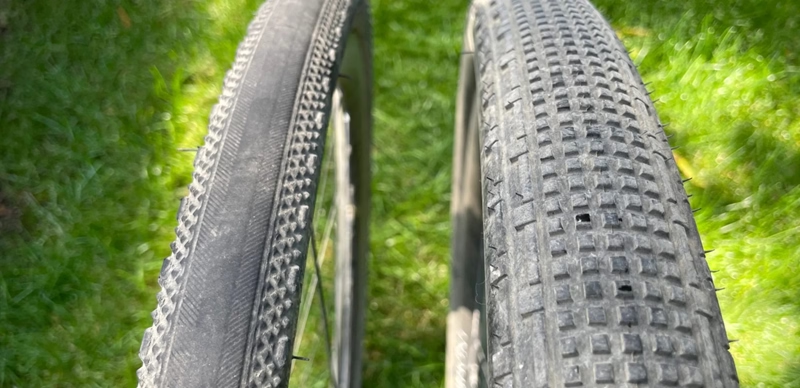
Clearly, gravel riding cannot stand apart from this “tire fattening” movement — especially since laboratory testing has confirmed the conclusion already proven in other fields: wider tires can reduce rolling resistance, and the effect is particularly pronounced on rough surfaces.
The key principle of efficiency
The core mechanism behind the efficiency gains of wider tires is the same across all disciplines: by reducing bouncing and brief moments of losing ground contact caused by uneven road surfaces, it prevents pedaling power from being lost during those microsecond-scale instants.

Laboratory tests with different wheel diameters prove that smaller-volume tires only have an advantage on absolutely smooth surfaces. In fact, even a 29×2.2-inch mountain bike tire can exhibit lower rolling resistance than common carbon gravel wheelset tire sizes — with current all-terrain-oriented 35 mm gravel tires showing resistance differences of up to 42 watts compared to mountain bike tires.
The trade-off between weight and resistance
The traditional view holds that the drawback of wider tires is increased weight. However, the additional power required to drive that extra weight is far smaller than the rolling resistance losses saved by the increase in tire volume. What’s more, wider tires do not require excessively reinforced casings; instead, they can achieve lighter weight and higher suppleness, which further optimizes rolling performance.
Advantages beyond power data

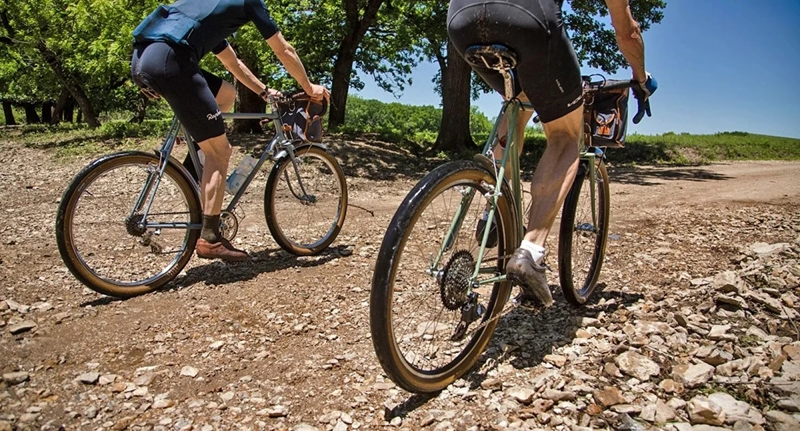
In typical gravel events that often cover ultra-long distances, wider tires offer another key advantage: they support significantly lower tire pressures without losing rolling efficiency, greatly improving ride comfort.
These advantages have now been widely recognized by competitive gravel riders. The scene at the first Gravel World Championships — where top riders all used road bikes fitted with cyclocross tires — may soon become history. In practice, 700x45c to 700x50c has already become the norm in racing, and on courses with high technical difficulty, some riders even go straight to XCO mountain bike tires.

The only unknown is where this “tire fattening competition” will end. Perhaps technology moves in cycles — if it continues, gravel bikes may lose their multi-purpose essence and eventually follow the same development path as mountain bikes.