





Wheel Lacing Patterns: Does More Crosses Mean Better?
Wheel Lacing Patterns: Does More Crosses Mean Better?
I believe everyone has noticed that there are many types of spoke arrangements among different wheel sets when purchasing them, but do you know what the differences between these arrangements are? Is it just for aesthetics? In this article, I will walk you through the differences in bicycle wheel spoke arrangements.

I. The Meaning of “Cross Number”
The most fundamental difference in spoke lacing patterns is the cross number, which is what we commonly refer to as “0X”, “1X”, where the number represents the amount of crossing. “0X” means no crossing at all, also known as radial lacing (or straight pull lacing).
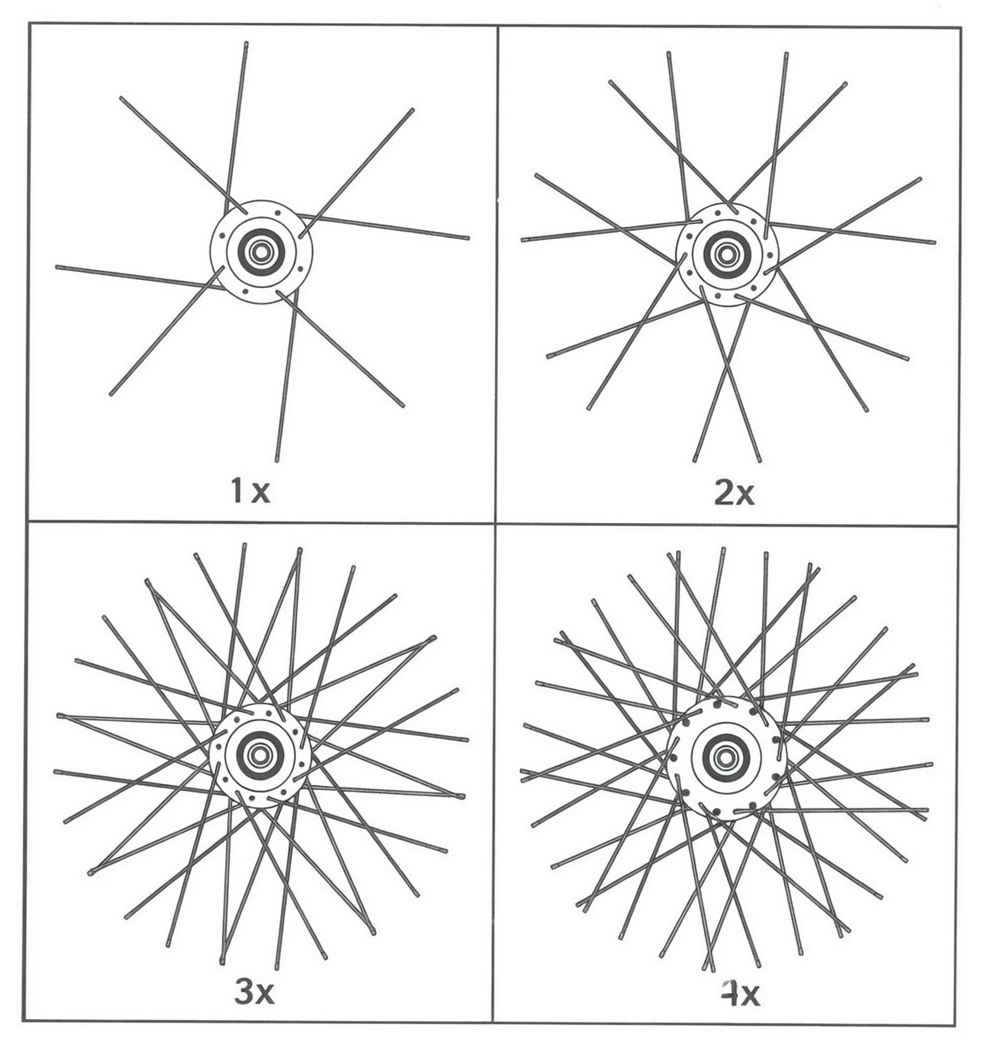
The higher the cross number, the more distributed the spoke tension, resulting in stronger lateral stiffness and anti-torsional capability. However, as the angle increases, the length grows longer, and the weight naturally increases as well, and vice versa.
Special note: disc brakes should avoid radial lacing, because the torsional force from disc brake braking will cause the spokes to loosen. Rim brakes have no such concern.
II. Introduction to Common Lacing Patterns
0X (Radial): Spokes connect directly from the hub to the rim without any crossing. This is the lightest option, with strong longitudinal stiffness, low wind resistance, and high transmission efficiency, but weak lateral stiffness and poor torsional resistance, making it incompatible with disc brakes. Typically used in carbon fiber wheel sets, the combination of carbon fiber and radial lacing achieves extreme weight reduction, suitable for road racing, and particularly advantageous for climbing.

1X: Each spoke crosses other spokes once. The spoke angle is relatively small, the weight is lighter, and the stiffness is slightly higher than “0X”, but it still cannot handle high-intensity riding. Commonly used on urban commuter bikes, folding bikes, and children’s bikes. Some disc brake applications are also compatible.

2X: Each spoke crosses twice. This pattern achieves a balance between weight and stiffness, suitable for most bicycles with no obvious weaknesses. It is a versatile all-rounder, seen in racing, commuting, and off-road applications, and is also a very common lacing pattern.

3X: Three crossings provide higher strength and durability, making it very suitable for rugged mountain terrain. This lacing pattern is also widely favored among cyclists. Ideal for mountain trail riding and cargo bicycles.

III. Mixed Lacing Patterns
Lacing patterns are certainly not one-size-fits-all. Different combinations are used depending on the scenario, and the front and rear wheels of the same bike may not necessarily use the same lacing pattern.
For the front wheel with rim brakes, a large proportion will choose radial lacing — not because cross lacing is inferior, but simply because it is unnecessary. For disc brakes, it is best to use 2X cross lacing to ensure safety. Most disc brake front wheels also opt for conventional lacing patterns.
The lacing combinations for the rear wheel are far more complex. For disc brake rear wheels, the left and right sides almost always use different lacing patterns — essentially a permutation and combination approach — mostly to balance left and right spoke tension and prevent lateral deviation. For example, the drive side uses radial lacing while the non-drive side uses 2X lacing. There is also the now-common 2:1 lacing (a ratio of 2:1 in spoke count and cross number between left and right), designed specifically to balance the pulling force on the non-drive side.
IV. Other Lacing Patterns
What remains are some unconventional lacing patterns.
For example, the star pattern lacing:

And CORIMAM’s unique “lacing” method, among others.

