Are Carbon Fiber Spokes Stronger Than Steel? Pros, Cons, and Real Performance Explained
Are carbon fiber spokes really stronger than steel ones? This is a common question among cyclists. A tiny spoke selling for dozens of dollars seems surprising—what exactly is the technology behind it? In this article, we will comprehensively analyze carbon fiber spokes from multiple perspectives, including technical principles, advantages and disadvantages, brand applications, and practical usage advice.
Technical Principles: What Makes Carbon Fiber Spokes Different?
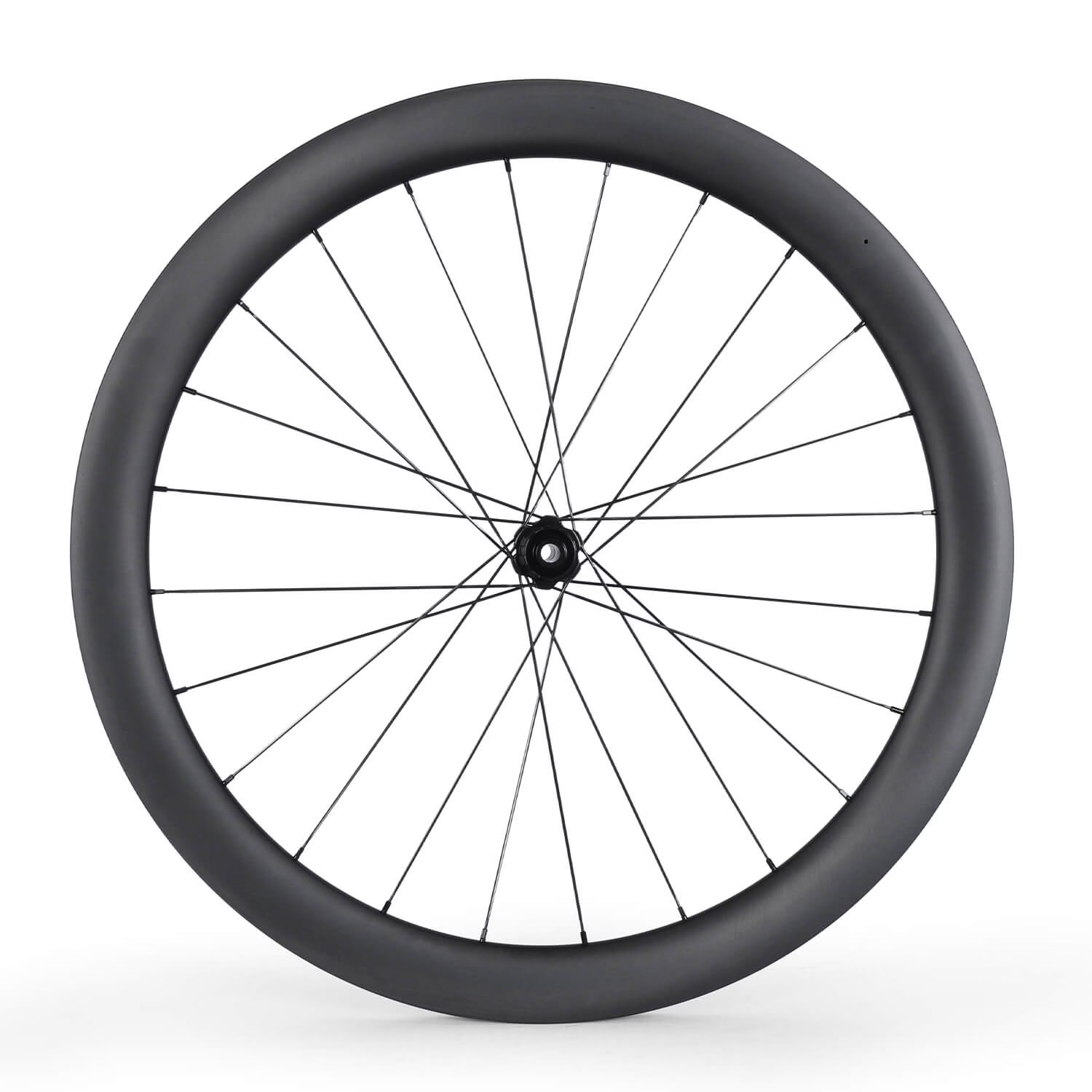
Carbon fiber spokes, as the name suggests, are wheel spokes made from carbon fiber composite materials, designed to replace traditional stainless steel spokes.
Carbon fiber has a much lower density than steel, giving it a natural advantage in weight reduction. Carbon spokes typically weigh around 2.5 grams each, roughly half the weight of steel spokes. For comparison, a commonly used steel spoke like the Sapim CX-Ray weighs about 4.75 grams.
In a wheelset with 24 spokes, switching to carbon spokes can reduce the total weight by at least 108 grams. Lighter spokes contribute to a lighter wheelset overall, which is particularly beneficial for road climbing or mountain trail riding.
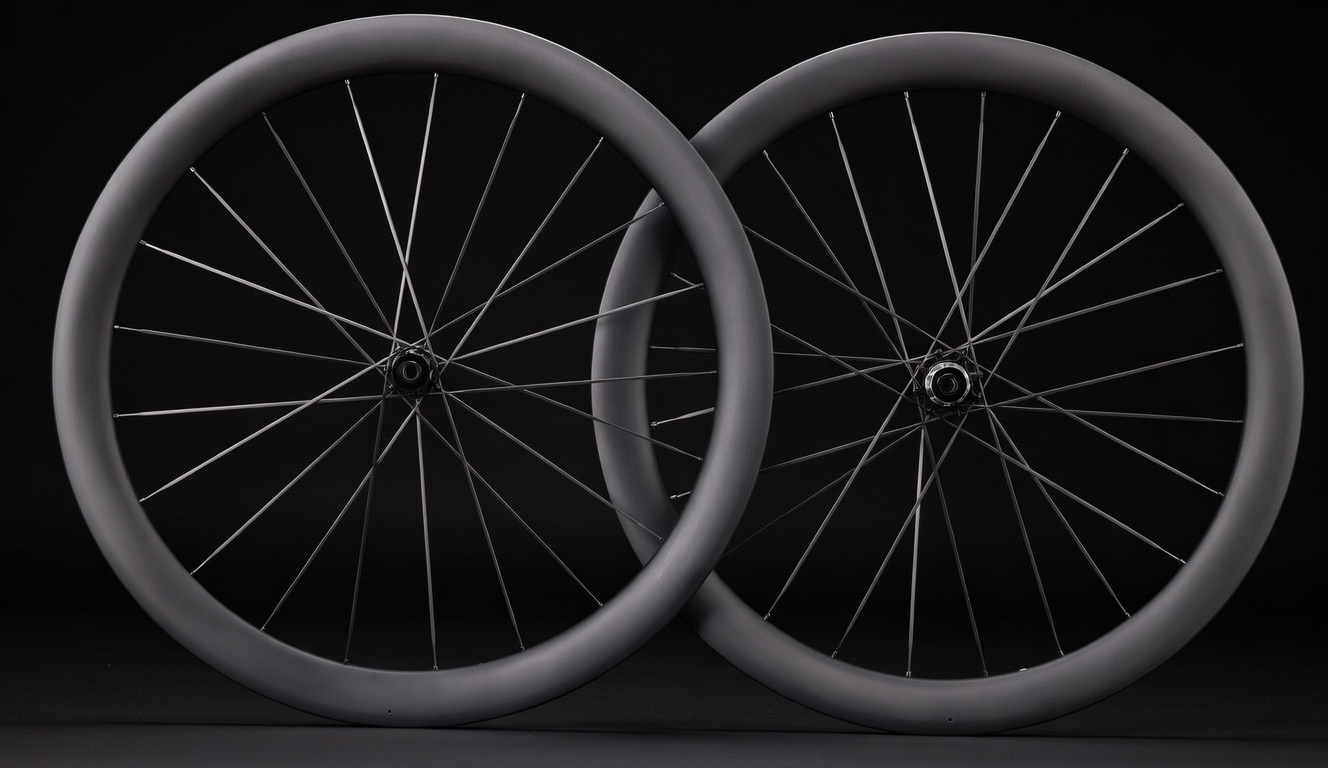

Carbon fiber spokes have extremely high tensile strength along the fiber direction, but they are relatively weaker in lateral and bending directions. This means carbon spokes are very strong when subjected to tension, but they cannot bend like steel spokes.
In other words, carbon fiber spokes can only handle tensile forces and cannot be bent into shape like traditional steel spokes during lacing. Therefore, wheel design and assembly methods must be adapted accordingly.
Many independent carbon spokes integrate metal fittings at both ends. One end uses a steel or titanium spoke nipple, while the other end features a threaded metal insert that secures the spoke to the hub or rim. This design prevents the carbon spoke itself from directly contacting the hub or rim and allows the spokes to be cross-laced into the wheel in a way similar to traditional steel spokes.
Because carbon spokes are stiffer and experience less elastic deformation, the wheel deforms less under load. During riding, the rim experiences cyclic loads that cause small deformations. If the spoke material has very little elongation, the wheel feels more direct during acceleration, without the energy loss sometimes associated with more elastic materials.
High-end carbon spokes can also withstand extremely high tension, which improves the overall stiffness and stability of the wheelset.
However, this also means that carbon spoke wheels provide less impact absorption. Steel spokes behave somewhat like springs, flexing slightly to absorb shock. Carbon fiber, with its low deformation capability, may snap under severe impacts rather than flex.
The Attractive Advantages of Carbon Fiber Spokes
Carbon spokes can reduce weight by 30%–50% compared with steel spokes. Every gram saved contributes to improved climbing and acceleration performance, making them particularly appealing for riders pursuing ultra-light setups.
Under the same performance parameters, carbon spokes can produce stiffer wheelsets. As some engineers describe it:
“With the same spoke cross-section, you can build a lighter wheel. With the same weight, you can build a stiffer wheel.”
Many riders report that carbon spoke wheelsets offer excellent lateral stiffness, allowing more direct power transfer during pedaling and extremely quick wheel response.
Carbon fiber materials can also be manufactured into wide, flat spoke shapes, potentially reducing frontal area and improving aerodynamics.
For example, the ICANBIKES Lightweight Carbon Spokes Wheelsets ICAN 40C UL & 50C UL use wide flat carbon spokes to improve torsional stiffness and durability. Compared with steel spokes, these flat carbon spokes can be stronger and more resistant to twisting forces.
In theory, carbon fiber spokes can also be integrated with rim shapes to create more streamlined structures, further optimizing aerodynamic performance.


The Unavoidable Disadvantages of Carbon Fiber Spokes
Carbon spokes are particularly vulnerable to lateral impacts.
In a crash or side impact, steel spokes may simply bend without breaking, but carbon spokes typically cannot tolerate such stress.
The co-founder of the wheel brand Scope Cycling, Busser, once stated:
“In terms of tensile strength, carbon fiber is extremely strong—we almost never see them break under tension. But under lateral impact they are very fragile compared with steel spokes.”
Repairing a wheelset with carbon spokes is also more complicated than repairing steel spoke wheels.
If an independent carbon spoke breaks, it must be replaced with the same specific model. For one-piece carbon wheels, repairs are often impossible.
Because carbon spokes cannot bend, the hub flanges and rim designs must be specialized to allow spokes to be inserted and fixed directly. Some carbon spoke systems use mortise-style interfaces or adhesive bonding techniques, requiring specialized tools during assembly to prevent twisting.
Adjusting spoke tension in carbon spokes also requires greater precision, since even small adjustments can affect rim trueness.
All of these factors increase the technical complexity of using carbon spoke wheels.
Additionally, carbon fiber materials and manufacturing processes are expensive. Since the technology is currently dominated by only a few suppliers, prices remain high. A single imported carbon spoke often costs tens of dollars, several times the price of a high-quality steel spoke.
Some industry experts believe that even if more manufacturers enter the market in the future, the price of carbon spokes is unlikely to decrease dramatically.
As a result, wheelsets using carbon spokes are typically flagship products within brand lineups.
Structural Trends: Who Is Using Carbon Spokes and How?
Although carbon fiber spoke technology first appeared in the 1990s, it remained a niche product for many years.
The German company Lightweight launched one of the first full carbon wheelsets in 1994. German cyclist Jan Ullrich used these wheels to win the Tour de France in 1997.
Today, more major wheel manufacturers are experimenting with carbon spoke designs, but their technical approaches vary significantly.
Separate Tensioned Carbon Spokes
This is currently the most common solution used by many brands.
In this design, the spokes, rim, and hub remain separate components, but the traditional steel spokes are replaced with carbon fiber ones.
During manufacturing, carbon spokes usually have metal fittings integrated at both ends. These are inserted into the hub flange and rim, then tightened using nipples to apply tension.
This structure is similar to traditional steel-spoke wheels and has the advantage that maintenance is relatively straightforward, since broken spokes can be replaced individually.
One-Piece Carbon Spoke Wheelsets


This design pushes lightweight performance to the extreme.
In a one-piece structure, the rim, spokes, and hub are molded or permanently bonded together during manufacturing, forming an inseparable structure.
The carbon spokes are directly integrated with the carbon rim and hub shell, creating a continuous carbon structure.
The benefit of this approach is structural optimization. Carbon fibers can run continuously from the rim to the hub, enabling maximum power transfer efficiency.
Wheelsets using this design feature uniform tension and do not require traditional spoke nipples.
This results in an extremely high stiffness-to-weight ratio and improved aerodynamic performance.
Additionally, one-piece carbon wheels can theoretically maintain their performance for life, since there are no threaded connections that may loosen or metal components that fatigue.
However, the trade-offs include very complex manufacturing, extremely high cost, and limited repairability.
Hybrid Structures and Innovations
Between the two extremes, some brands are exploring hybrid solutions.
For example, CADEX uses short carbon spokes bonded to specially designed hub flanges. In this system, the spokes do not run all the way through the rim but are bonded at the hub interface.
This approach creates a structure similar to an integrated system while still allowing some degree of serviceability at the hub side.
Conclusion
Overall, major wheel brands have different attitudes and strategies toward carbon fiber spokes.
Some pursue ultimate performance, even if it means sacrificing repairability. Others adopt a more gradual approach, reducing weight through independent carbon spokes while maintaining serviceability. Meanwhile, some premium brands remain cautious and continue to rely primarily on steel spokes.
From an industry perspective, carbon fiber spokes are unlikely to completely replace steel spokes in the near future. Instead, they will mainly appear in high-end wheelset models.
For everyday riders, the choice between carbon spokes and steel spokes ultimately comes down to personal priorities.
Do you want maximum performance, or do you prefer reliability and practicality?
If you are a competitive racer or a high-end enthusiast, carbon fiber spokes may become your secret weapon. But if you simply enjoy riding and value cost-effectiveness and durability, a high-quality traditional steel-spoke wheelset will remain a dependable choice.
Hopefully this analysis helps you make a more informed upgrade decision, allowing you to choose the wheelset that best suits your riding style—enjoying both the speed enabled by advanced technology and the pure pleasure of cycling.
Carbon Fiber Spokes vs Steel Spokes Comparison
| Feature | Carbon Fiber Spokes | Steel Spokes |
|---|---|---|
| Weight (per spoke) | ~2.5 g | ~4.5–5 g |
| Tensile Strength | Very high | High |
| Lateral Impact Resistance | Lower | Higher |
| Stiffness | Very high | Moderate |
| Repairability | Difficult | Easy |
| Cost | Very expensive | Affordable |