Why Do Pro Cyclists Use Increasingly Larger Chainrings? And Should You Follow Suit?

If you’ve been following professional road racing lately, you’ve probably noticed a clear trend: chainrings are getting bigger. The traditional “standard crankset” of 53/39T has long been the default in the peloton, but today, 54T, 55T, and even larger big rings are becoming commonplace — not just in time trials, but in grand tours and classics too.
Shimano’s flagship Dura-Ace Di2 R9200, launched in 2021, replaced the classic 53/39T with a 54/40T option as standard. Some riders go even further: 56T, 58T, 60T, and beyond have all appeared in WorldTour races. In the 2024 Tour of UAE, Ineos Grenadiers’ Tobias Foss used a monstrous 68T chainring in the time trial, while teammates Josh Tarling and Ben Turner rolled 60T and 62T rings at Paris-Roubaix.

The question is obvious: pros are undeniably faster than ever — but do they really need chainrings this big? Or is there more to this trend than just raw speed?
Pros are getting faster — but that’s not the whole story
It’s hard to make blanket statements about WorldTour speeds because races, tactics, and courses vary so much year to year. That said, average speeds have clearly trended upward in recent years.
Take Paris-Roubaix: the winning average speed has increased in each of the last three editions. Many factors contribute: widespread adoption of aerodynamic equipment, near-universal use of power meters, dramatically better understanding of rolling resistance, and huge advances in nutrition and recovery.
All of these gains mean riders can sustain higher speeds for longer. And to sustain higher speeds at a given cadence, you need higher gear ratios — which is one reason bigger chainrings are appealing.
Doesn’t a 10T cog make chainrings smaller?

You’d think so. The arrival of 10T small cogs (on SRAM Red/Force and Campagnolo Super Record) has allowed brands to offer “sub-compact” and “semi-compact” cranksets with dramatically wider ranges: 50/37T, 48/35T, 46/33T, or even Campy’s 45/29T.
In theory, a 50/10T combo gives the same top gear as a traditional 53/11T, but with a lighter system and much easier climbing gears.
Yet even riders sponsored by these brands frequently choose larger chainrings anyway. Why give up the weight and range advantage?
Bigger chainrings are simply more efficient
The answer is surprisingly simple: all else being equal, larger chainrings (and larger cogs) are more mechanically efficient.
Independent testing by Friction Facts (now owned by CeramicSpeed) showed that a 39×11T gear combination (common with smaller chainrings + 11T cog) produces roughly 1.5 W more frictional loss than a 53×15T combination with nearly identical gear ratio.
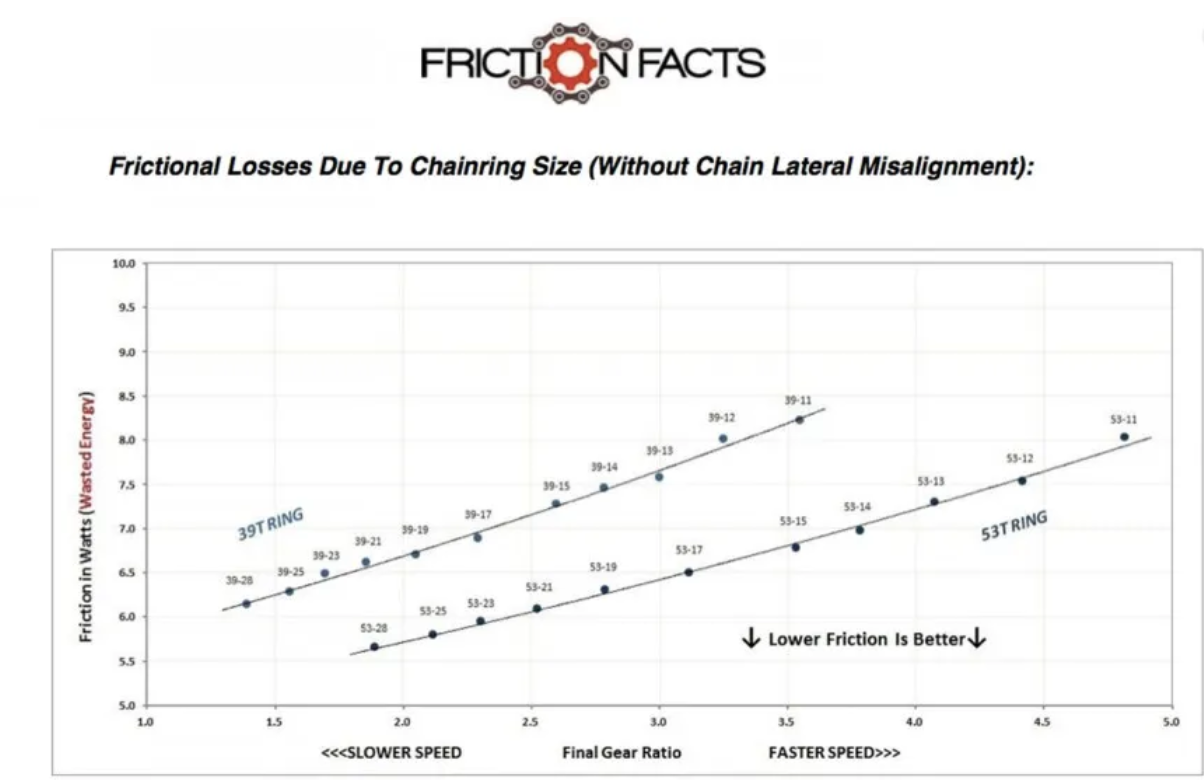

Why? Two main reasons:
- Larger sprockets reduce chain tension per link and reduce the number of chain articulations per pedal stroke.
- Larger chainrings + mid-cassette cogs keep the chainline straighter, dramatically reducing cross-chaining losses.
The same principle explains why oversized derailleur pulley wheels (OSPW) work: fewer, gentler chain bends = less energy lost to friction.
In real-world 11- or 12-speed cassettes, extreme cross-chaining (e.g., small ring + 11T or 12T cog) can add several watts of loss. Using a big chainring keeps you in the sweeter spot of the cassette (14–17T range) where the chain runs almost straight — a measurable advantage when you’re already producing 400+ watts for hours.
Pioneers like four-time world TT champion Tony Martin were early adopters, regularly running 58T (and larger) rings paired with wide-range cassettes. Today the trend has gone mainstream.
Should amateur riders copy the pros?
It’s tempting to think: “If the pros do it, it must be better.” But for chainring size, the answer is usually no.
While bigger chainrings are marginally more efficient, that advantage only materialises when you actually use them. If you slap a 54–56T big ring on your bike but spend half your ride in the small ring on climbs, you’ve just made your chainline worse for a large portion of your riding — wiping out the efficiency gain and possibly making things slower.
For most amateurs, especially those with one do-it-all bike, the smart choice is still optimising overall gear range for the terrain you actually ride. A wide-range 50/34 or 48/32 compact (or even sub-compact) crankset paired with an 11-34 or larger cassette usually makes far more sense than a massive pro-style big ring.
There are exceptions: if you live in a pancake-flat area, ride mostly solo or in fast groups, and rarely need easy gears, then experimenting with 54T+ chainrings can make sense — especially if you value that last 1–2 W of efficiency.
For chain life, bigger rings and cogs do reduce wear (less tension, fewer articulations), but in everyday use the biggest durability gains still come from keeping everything clean and using high-quality chain lube.
Bottom line
Pros use huge chainrings because at their level, every watt matters, and bigger rings + straighter chainlines = free speed when you’re already pushing the limits of human performance.
For the vast majority of amateur cyclists, the practical benefits are tiny compared to the drawbacks in climbing and versatility.
So admire the 60T+ monsters from afar — but unless you’re chasing KOMs at 450 W on the flats, your money is better spent elsewhere.